Directional Codes: a new family of quantum LDPC codes on hexagonal- and square-grid connectivity hardware
Note: This abstract is based on an in-progress revision of the arXiv manuscript. The key conclusions remain the same, though there are some differences worth noting. In the revision, we (1) compare directional codes with the rotated toric code (RTC) instead of the planar surface code; (2) consider new better-performing instances of directional codes, which differ in the choice of the torus only; (3) decode our simulations using Tesseract short-beam.
Utility-scale quantum computing requires quantum error correction to protect quantum information against noise. Currently, superconducting hardware is a promising candidate for achieving fault tolerance due to its fast gate times and feasible scalability. However, it is often restricted to two-dimensional nearest-neighbour connectivity, which is thought to be incapable of accommodating high-rate quantum low-density parity-check (qLDPC) codes that promise to greatly reduce the number of physical qubits needed to encode logical qubits.
In this paper we construct a new family of qLDPC codes, which we call "directional codes", that outperforms the rotated toric code (RTC) while meeting square-grid connectivity requirements locally, and some even hexagonal-grid. The key idea is to utilise the iSWAP gate — a promising two-qubit gate on superconducting QPUs — to construct circuits that measure the stabilisers of these qLDPC codes without the addition of non-local connections.
Choosing well-performing directional code instances that encode 4, 6, 12 and 18 logical qubits, we numerically evaluate their performance. Despite requiring the same connectivity as the RTC, we find multiple directional code families that outperform it. Most notably, the best-performing sub-family found and simulated uses only 25-35% of the physical qubits to achieve the same logical error rate as the RTC.
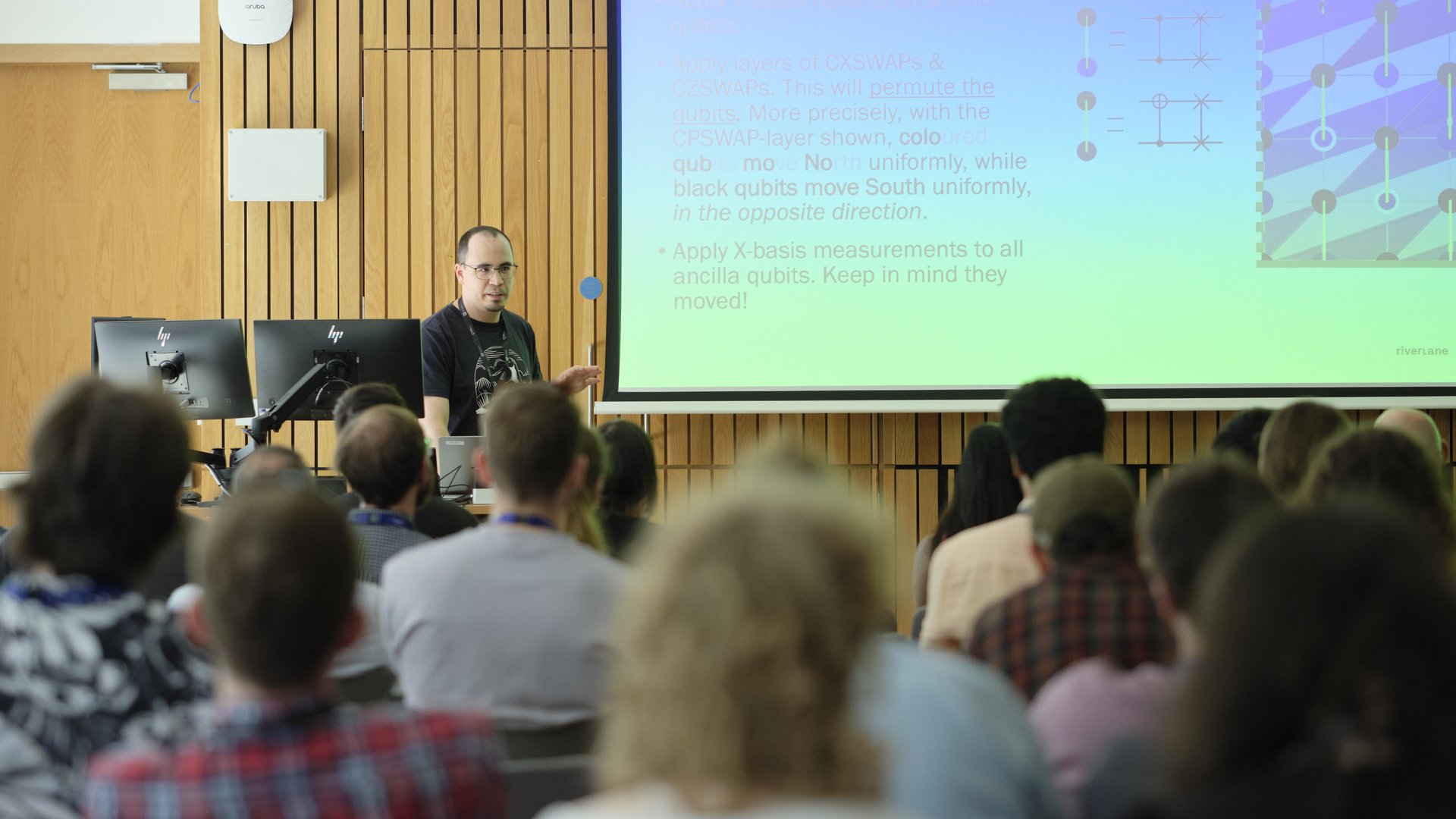
Event Photos
View all